From data to decision in 2025
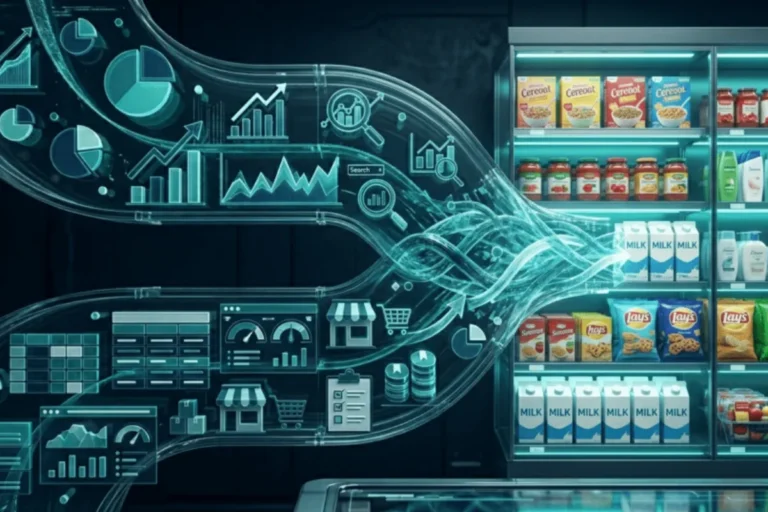
Data has become the most valuable input for any organization. In 2025, the Big Data, Business Intelligence, and Artificial Intelligence to increase sales they are indispensable tools for competing in the mass consumer and retail market.
While in 2022 Big Data and business intelligence were beginning to make a difference, today in 2025 we are experiencing a complete revolution thanks to Artificial Intelligence. And the figures prove it: the Analysts' 97% already uses AI to speed up its analytics processes, and the 87% uses automation to generate real-time insights.
What catches our attention the most is how this has changed the speed of business decisions. Consumer goods companies that used to take weeks to analyze trends now do so in hours.
For this very reason, we share with you three strategies that we have seen work time and time again to empower distribution channels and skyrocket sales results.
Strategy 1: Data quality as a foundation
We want to be honest with you: having mountains of data is useless if it's a mess. It's like trying to cook with spoiled ingredients.
The reality is that data quality remains the biggest headache for many companies. But in 2025, those who have managed to master data governance and validation are seeing incredible results, as confirmed by BARC Research (2025).
What do you achieve when you have your data in order?
- Sales and inventory insights you can actually use
- Reports Your Sales Teams Trust 100%
- Zero decisions based on misinformation (and the losses this avoids)
Strategy 2: From looking at the past to predicting the future
Here is where things get really exciting. The companies that are winning are no longer satisfied with knowing what happened the previous week. They want to know what is going to happen the next one.
The combination of Big Data, BI, and AI models is enabling them to:
- Anticipate stockouts before they happen
- Detect new consumption patterns that the competition doesn't see yet
- Adjusting prices or launching promotions at the exact right moment
The MIT Sloan Review It projects that predictive analytics will be the standard in the next three years.
Strategy 3: The power of «where» in your data
One of the things that fascinates us most about modern data analytics is how georeferencing has completely changed the game. It is no longer enough to know how much you sold; you need to know exactly where you sold it.
Heat maps have become the favorite tool of many business managers because they allow them to:
- Instantly detect where sales are dropping
- Evaluate whether your distributors are truly covering your entire area
- Redesign trade routes that actually work
But here is a key thing that many overlook: data visualization. According to TechRadar, when you’re able to tell compelling stories with your data, you can improve business performance by up to 20%. Why? Because you reduce the «data anxiety» that many sales teams experience.
The real obstacles (that no one tells you about)
Let's be honest: implementing all of this is no bed of roses. I've seen companies stumble over the same problems time and time again:
Initial costs hurt. Investment in infrastructure and team training is significant, especially for medium-sized companies.
Resistance to change is real. There is always someone on the sales team who prefers «to do things the way we've always done them.»
Democratic access to data remains a challenge. According to Gartner (2025), many companies have the information, but only a few can interpret and use it. The goal is for any employee to be able to make data-driven decisions.
After seeing dozens of implementations, we can have only one certainty: Big Data, Business Intelligence, and Artificial Intelligence are no longer «technologies of the future.» They are tools of the present.
In 2025, companies that take advantage of them are not only selling more; they are operating better and keeping customers happier. Those that do not are simply falling behind in a market that shows no mercy.
The question you should be asking yourself is not whether your company needs these technologies. It is when you are going to start using them before it is too late.