Information was never the problem. The problem was always what to do with her.
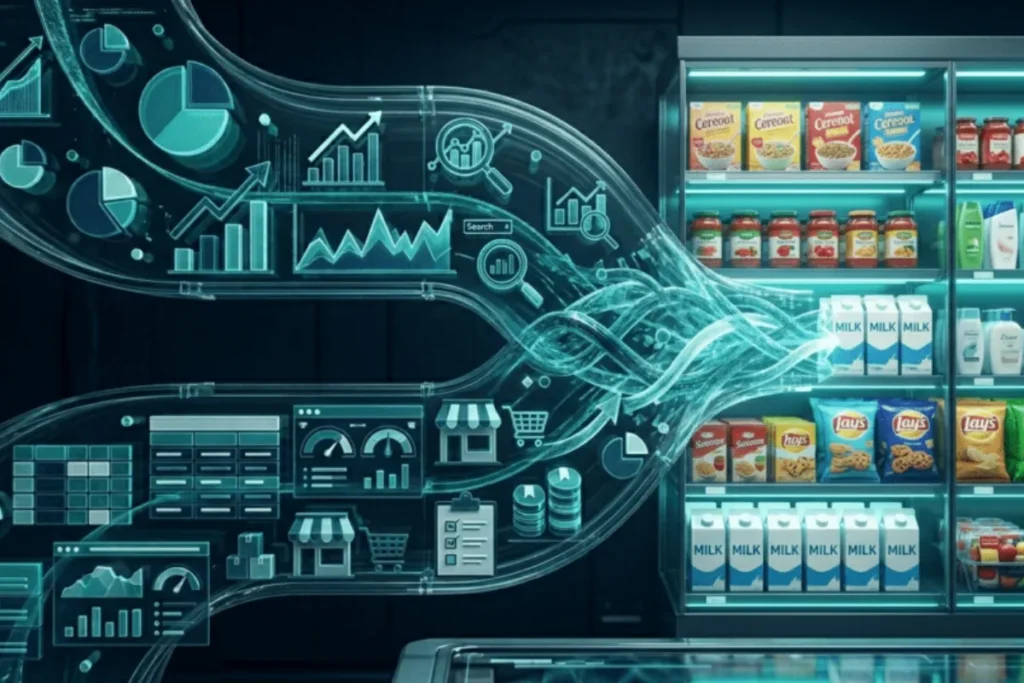
In 2026, most consumer packaged goods companies have access to more data than ever before. And yet, many still make decisions in the dark—not due to a lack of information, but because their sources do not speak to one another.
Two parallel worlds that never intersect. And a huge gap between what the strategy says and what happens at the point of sale.
What market research tells you (and what it doesn't tell you)
Market share, consumer behavior, and category evolution studies remain key tools. No one disputes that.
They help you understand the context: how your category is growing, where the competition stands, what trends are emerging. They are the map of the territory. In fact, according to Kantar, the companies that are winning in retail are those that combine advanced analytics with a clear vision of consumer behavior to detect growth opportunities before the competition.
But they have a very specific limit: They don't tell you where to perform tomorrow.
The refresh rate is low. The level of aggregation is high. And when you want to drill down to the specific point of sale, the information gets blurry. They are useful for planning medium- and long-term strategy, not for executing this week.
The asset you already have and are probably underutilizing
Meanwhile, a huge amount of data is generated in your own operation every day:
- Sales by SKU
- Distributor data
- Field execution
- Price and promotion history
- Compliance with trade routes
This information has something that no external study can provide: real granularity, daily frequency, and direct proximity to what is happening in the business.
The problem is that in most organizations, that data is used to report the past, not to guide the future.
What happens when the sources do not connect?
The result is usually always the same: well-designed strategies that are poorly executed.
A study may show that a category is growing strongly in a given region. Excellent sign. But without the operational data to cross-reference it with, it is not possible to answer the questions that really matter:
- At which specific points of sale do we need to take action?
- Which products should be prioritized?
- What is the team in the field doing this week?
It is not a new problem. Harvard Business Review warns that most decision-making errors do not come from having too little data, but from not knowing how to correctly integrate the available internal and external sources.
The logic that the most advanced organizations are adopting
It is not a question of choosing between external studies and internal data. It is about understanding that they serve different functions and that, together, they are much more powerful.
Studies provide context and strategic direction. Internal data allows for execution with precision and speed.
When integrated well, the result changes significantly:
- Opportunities are detected earlier
- Points of sale with the highest potential impact are prioritized
- The strategies are adjusted in much shorter cycles
- Planning connects with actual execution
The real impact is on the ground
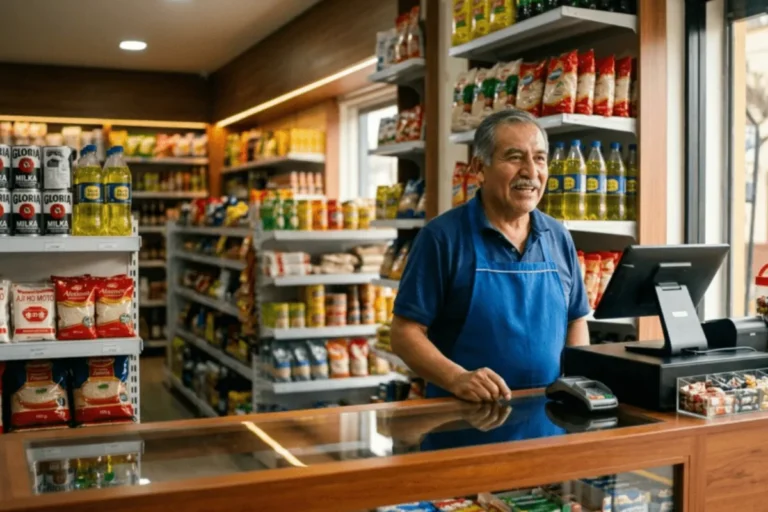
All of this makes sense when it reaches the point of sale.
Source integration is not an analytical exercise. It is an execution tool. When it works well, commercial teams go out into the field with clear priorities, not intuition.
That transforms every visit: more focus, greater effectiveness, measurable results.
Why technology is the bridge
Doing this integration manually does not scale. It takes too much time, too many intermediaries, and too many review cycles.
That is why more and more organizations are adopting platforms that unify these sources and turn information into actionable decisions — tools that connect data from distributors, points of sale, and commercial operations, and translate them into concrete tasks for teams in the field.
Information ceases to be a passive asset. It becomes a real competitive advantage.
The real difference in 2026
In an environment where all companies have access to similar information, the difference will not be in who has more data, but in who manages to:
- Integrate different sources intelligently
- Reduce the time between insight and action
- Execute with a focus on the highest-impact points
- Measure results and learn quickly
Companies that continue to operate with disconnected sources will have a partial view of the business. Those that manage to integrate them will be better prepared to compete in increasingly demanding markets.
Market studies and internal data do not compete with each other. They complement each other.
But only when properly integrated do they allow closing the gap between strategy and execution. In 2026, the most effective business decisions will not come from looking at a single source; they will come from building a complete vision that allows acting with precision at the point of sale.